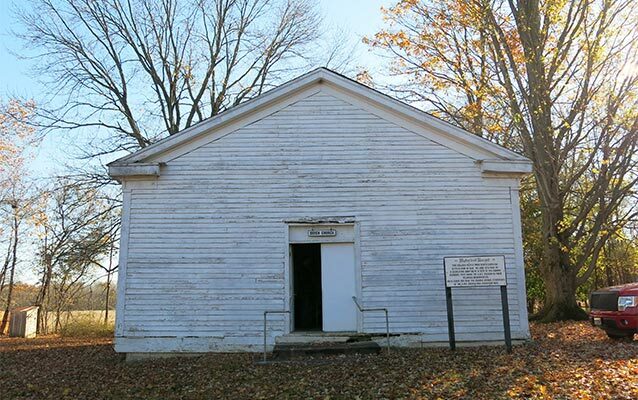
The Beech Church and Settlement
location_fill IndicacionesFree people of color were drawn to settle near Ripley Township, a predominantly Quaker settlement, with the promise of affordable land and friendly neighbors. The 1830 U.S. Census reported 14 Black households with a total of 91 individuals in the area. By the mid-1830s, Ripley township boasted over 400 Black residents, many moving from the US South.
The Blue River Congregation of Rush County goes back to 1832 when the early congregants resolved to adopt the AME Church as their denomination. Early leaders included Bishop Morris Brown and Rev. William Paul Quinn. The Blue River Church initially met in a log meeting house but replaced it with a frame building in 1838. From 1840-45, the Blue River Congregation is recorded as having around 102 members. The adjacent gravesite served as the resting place for Black residents of Rush County until the early 20th century.
Blue River was the site of ‘The Indiana Conference’ on October 2nd, 1840. The Indiana Conference organized the varying groups of religious followers into one central body. Morris Brown presided over the meeting, placing William Paul Quinn in charge of the circuit of Indiana AME Churches. The conference recorded forty-five AME congregations in Indiana. Indiana was the sixth AME conference founded and the fifth founded in the United States.
Blue River is a simple, single-room, gable-front, wood-frame building. The siding and roof shape are meant to resemble a Greek-revival setting. Greek-revival architecture, common in the US from the 1830s to 1860s, was heavily inspired by the architecture of classic Greek temples. Some characteristics of this style include triangular or gabled roofs with ends that continue into the center of the building and clapboard or paneled exteriors. The original 1838 building still stands. Since 1914, descendants of the Beech Settlement return to Blue River every August. Blue River remains one of the few sites associated with the rural Black community of Indiana. The site has also been referred to as ‘The Beech Church’ and ‘Point Pleasant’. The Beech Church has been listed in the National Register of Historic Places since 2018.
-
Discover IndianaCC-BY-NC-SA